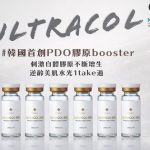

Many people considering seeking cosmetic treatments in Korea often come across two terms during their research: “Ultracol collagen injections” and “growth factors.” Both are used in collagen regeneration and claim to “stimulate the skin’s natural repair process,” which can lead to confusion—some might even assume that Ultracol is a type of growth factor. So, what exactly are the ingredients of Ultracol, and what are the fundamental differences between it and growth factors? This article will clarify these points from four key aspects: composition, mechanism of action, effects, and safety.

What are Ultracol collagen injections?
Ultracol (also known as Ultracol 100 or Ultracol 200) is a popular collagen-stimulating filler in Korea, primarily used to address nasolabial folds, hollow cheeks, sunken temples, and for contouring. Although its name contains “collagen,” Ultracol itself is not a collagen preparation nor is it derived from human or animal sources. It is a cosmetic material that indirectly stimulates the production of natural collagen through absorbable materials in the body, falling under the category of “biostimulatory fillers.”
Ultracol is available in two different formulations:
- Ultracol 100: This version contains an appropriate amount of PDO microspheres and is suitable for treating superficial wrinkles, such as those around the eyes, nasolabial folds, and crow’s feet.
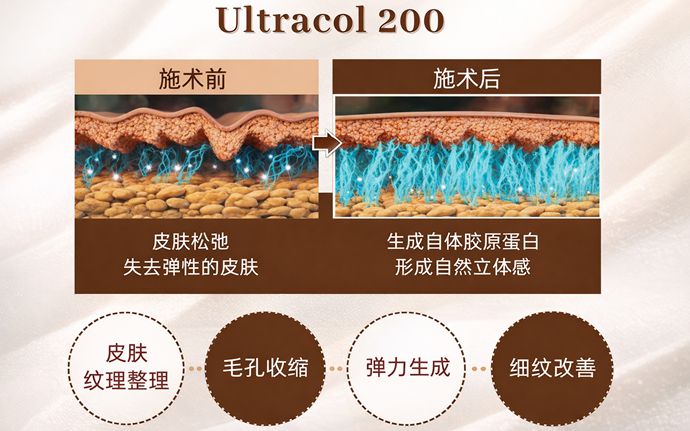
- Ultracol 200: With a higher concentration of PDO microspheres and larger particles, this formula is better suited for deeper fillings and contouring, especially for areas with significant loss of facial volume, such as the cheeks and temples, or for shaping the jawline.
The two main components of Ultracol are:
- PDO (Polydioxanone) microspheres: Originally used as absorbable sutures in surgery, PDO has a proven medical history of over 30 years. In Ultracol, these microspheres are ground into extremely fine particles. Once injected into the dermis, they are completely absorbed by the body within 6 to 8 months. During this process, the microspheres continuously stimulate fibroblast cells, promoting the production and deposition of large amounts of natural collagen.
- SCMC (Carboxymethyl Cellulose Gel): Serving as an immediate filling agent, SCMC provides immediate support to sunken areas after injection, resulting in immediate visible results. As the SCMC gel is gradually absorbed by the body, the collagen network stimulated by the PDO microspheres also takes shape, creating a combined effect that provides both immediate and long-lasting benefits.
Therefore, the collagen regeneration induced by Ultracol is a result of the body’s own repair processes triggered by exogenous PDO materials, rather than a direct supplementation of exogenous collagen proteins or any form of growth factors.
II. What are growth factors?
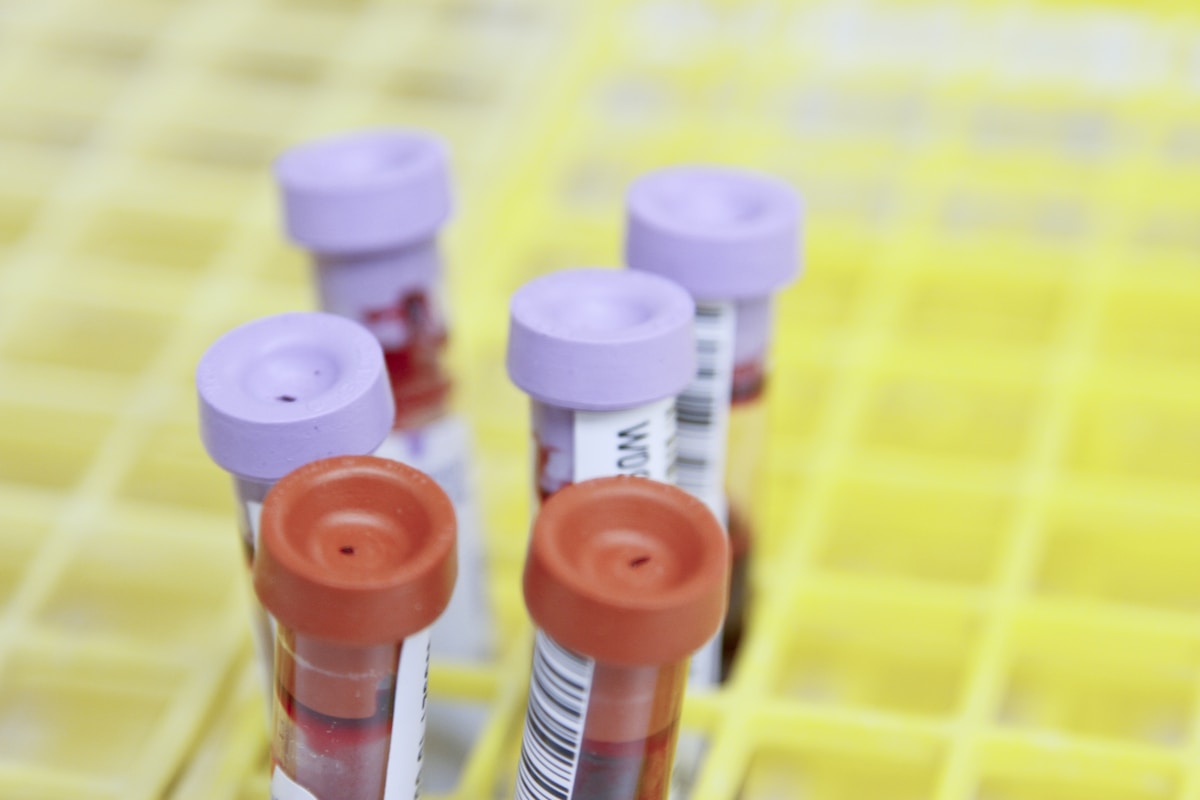
Growth Factors are a class of bioactive protein signaling molecules that exist naturally in the human body. They can regulate cell proliferation, differentiation, migration, and repair. In the fields of medicine and medical aesthetics, common growth factors include:
- EGF (Epidermal Growth Factor): Promotes the division of epidermal cells and accelerates wound healing. It is commonly found in post-surgical recovery products and after-laser care treatments.
- bFGF (Basic Fibroblast Growth Factor): Stimulates the proliferation of fibroblasts in the dermis, promoting the synthesis of collagen and elastin. It is a frequently used factor for improving wrinkles and sagging skin.
- PDGF (Platelet-Derived Growth Factor): Regulates angiogenesis and tissue repair. It is commonly used in hair loss treatments and scar repair.
- TGF-β (Transforming Growth Factor β): Modulates immune responses and the synthesis of extracellular matrix, affecting wound healing and tissue remodeling.
In medical aesthetic treatments, growth factors are usually administered in the form of lyophilized powder injections or essences, delivered to the skin through microneedling, hyaluronic acid injections, or direct injection. However, the use of growth factor injections without strict medical supervision carries certain risks—improper dosage control may lead to side effects such as excessive tissue proliferation, resulting in lumps, granulomas, or even tissue deformation. This is also the main reason why many countries have adopted a cautious approach to the use of growth factor injections in recent years.
III. The key differences between Ultracol and growth factors
The confusion between Ultracol and growth factors stems from their ultimate connection to “collagen.” However, there are fundamental differences between them in terms of composition and mechanism of action:
1. Their chemical properties are completely different.
Ultracol’s core components are PDO absorbable sutures and SCMC gel carriers, both of which are widely used in medical procedures. These materials are biocompatible and safe, having received certifications from the Korean KFDA and the European Union’s CE mark. Growth factors, on the other hand, are protein signaling molecules derived from biotechnology or human sources. Their molecular structure is entirely different from that of PDO, so they do not belong to the same category of substances.
2. Their mechanisms of action are also fundamentally different.
Ultracol’s collagen regeneration is a “material-induced” process: As the PDO microspheres are absorbed by the body, they are recognized as foreign substances by the immune system, triggering a mild foreign body reaction that stimulates fibroblasts to produce new collagen around them. This entire process is physico-chemically induced; the material itself does not act as a signaling molecule.
Growth factors, however, function in a “signal-regulating” manner: After injection, they bind directly to receptors on cell surfaces, activating cellular signaling pathways such as MAPK and PI3K, and instructing cells to accelerate proliferation and collagen synthesis. The essential difference between the two is akin to the distinction between “teaching a fish to swim” and “directly giving the fish food”—one is an indirect approach, while the other is a direct intervention.
3. The time it takes for effects to become apparent varies.
Ultracol’s collagen regeneration takes time, with the most noticeable results typically appearing 1 to 3 months after injection. This is because the PDO microspheres need to be gradually absorbed by the body, and collagen production requires a complete healing cycle (usually 28 to 45 days). SCMC gel, on the other hand, provides immediate support after surgery, resulting in visible improvements in contour almost immediately. The effects of growth factors may be more rapid, depending on the type, concentration, and individual cellular response.
4>There are also significant differences in their safety profiles.
The PDO material used in Ultracol has accumulated numerous clinical cases worldwide, and its predictability and safety have been widely recognized. Since PDO is completely absorbed and metabolized by the human body without remaining in the body for an extended period, the likelihood of causing uncontrolled proliferation is extremely low.
However, if the dosage or concentration of growth factor injections is improper, there is a risk of causing uncontrolled excessive tissue proliferation. Although this risk can be significantly reduced when administered by professional physicians in regular medical institutions, it still needs to be taken seriously. This is also why regular plastic surgery hospitals in South Korea generally adopt a cautious approach to the clinical use of growth factor injections.

IV. Comparison of Ultracol with other common collagen injections
In the South Korean cosmetic market, Ultracol is often compared with several other collagen-based stimulant injections. It is important to note that these injections are not growth factors; their common feature is that they all belong to the category of “biostimulatory fillers”:
| Injection Name | Main Ingredients | Mechanism of Action | Indicated Areas |
|---|---|---|---|
| Ultracol | PDO microspheres + SCMC gel | Immediate filling + PDO-induced collagen regeneration | Forehead wrinkles, apple cheeks, temples, chin |
| Juvelook | PDLLA microspheres | Microspheres stimulate collagen regeneration | Overall skin quality, pores, mild depressions |
| Sculptra | PLLA polylactic acid | Delayed collagen regeneration | Large-area filling of the cheeks and temples |
| Derma Veil | PLLA + glycolic acid | Mild, gradual collagen regeneration | Improvement of overall skin quality across the face |
The main difference between Ultracol and the youth-enhancing needle series (such as Sculptra, Juvelook) is that Ultracol’s SCMC gel provides immediate filling effects, with visible contour improvements right after the procedure; the needle series, on the other hand, rely more on the delayed effects of collagen production after treatment. Ultracol offers more immediate and direct results in filling wrinkles, making it ideal for consumers who want to see quick improvements.

V. Post-treatment precautions for Ultracol
- Massage daily for 5 minutes, 5 times a day, within 5 days after the procedure to help distribute the PDO microspheres evenly and prevent lumps from forming.
- Avoid high-temperature environments for one week: refrain from saunas, hot baths, and spas, as high temperatures can accelerate the breakdown of PDO and affect the final results.
- Avoid alcohol and intense exercise: Reduce alcohol intake and high-intensity exercise for one week after the procedure.
- Strengthen moisturization and sun protection: During the collagen regeneration period, the skin is more sensitive to external stimuli, so it is important to take basic protective measures.
- Be patient with the results: Ultracol is not a quick-acting filler; the peak effect is usually seen 4 to 6 weeks after the procedure. Do not worry too much if you do not notice immediate results.
VI. Common Questions and Answers
Q1: Are Ultracol collagen injections growth factors? A: No. The main c
omponents of Ultracol are PDO absorbable microspheres and SCMC gel, which are physico-chemically induced collagen-stimulating materials. They are completely different from growth factors in terms of composition, structure, and mechanism of action.
Q2: How long does the effect of Ultracol last? A: The effects of a singl
e treatment usually last around 18 to 24 months, depending on individual factors such as body type, lifestyle, and the amount of the injection.
Q3: Who is suitable for Ultracol? A: Adults who wish to i
mprove nasolabial folds, hollow cheeks, sunken temples, marionette lines, and the jawline, while seeking natural and gradual results, are suitable for this treatment.
Q4: Is Ultracol safe? A: The PDO material is high
ly safe and has been approved by KFDA and CE. It has a clinical history of over 30 years. The most common side effects are temporary redness or mild bruising at the injection site, which usually subside within a few days.
Q5: Can Ultracol be used together with growth factor products? A: It is not recommended to
use Ultracol and growth factor products at the same time in the same area to avoid excessive stimulation or unexpected tissue reactions. If a combined treatment is needed, a professional doctor should assess the situation and determine a safe interval between the treatments.
Q6: Can pregnant or breastfeeding women receive Ultracol injections? A: Currently, there is
not enough clinical data to confirm the safety of using Ultracol during pregnancy or breastfeeding. It is advised to postpone the treatment until after these periods have ended.
VII. Conclusion
In summary, Ultracol collagen injections are not growth factors. There are fundamental differences between the two in terms of composition, mechanism of action, and safety profile: Ultracol uses PDO absorbable material as its core and induces the production of natural collagen through physical-chemical processes; growth factors, on the other hand, are protein signaling molecules that directly regulate cellular behavior. Ultracol offers greater predictability and controllability and is currently a safe filler option widely used by reputable plastic surgery clinics in Korea.
If you are considering undergoing Ultracol treatment in Korea, it is recommended to choose a qualified and reputable plastic surgery clinic. Have a consultation with an experienced specialist and make sure you fully understand your skin condition and the desired results before the procedure. Choosing a legitimate channel and a professional team is the key to achieving safe and satisfactory results.