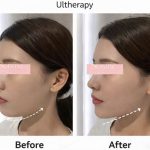

Since its introduction, the U.S.-developed Ultherapy® has become the gold standard for non-surgical anti-aging treatments, with over 3 million treatment records worldwide due to its FDA-approved non-invasive results. The recent launch of the second-generation Ultherapy Prime® has left many potential patients wondering: “Is the second generation really better than the first? How significant is the difference in effectiveness? Is the extra cost worth it?”
This article will provide a comprehensive side-by-side comparison of the first and second generations of U.S.-developed Ultherapy from six key aspects: technical specifications, treatment outcomes, pain levels, treatment duration, price differences, and suitable candidates, to help you make the best decision for yourself.
First-generation U.S.-developed Ultherapy®: 16 years of proven effectiveness

Since receiving FDA approval in 2009, the first-generation Ultherapy® has undergone 16 years of clinical testing worldwide, accumulating extensive real-world treatment data and positive reviews. Its core principle involves using high-intensity focused ultrasound (HIFU) to precisely target the SMAS fascia layer (at a depth of 4.5 mm), creating microthermal damage points without damaging the epidermis, thereby stimulating collagen regeneration and restructuring.
Key specifications of the first generation
- Treatment depths: three options – 1.5 mm (superficial dermis), 3.0 mm (deep dermis), 4.5 mm (SMAS fascia layer)
- Imaging system: Equipped with DeepSEE® real-time ultrasound technology, screen size approximately 14–15 inches
- Energy output: Standard microfocused ultrasound, with stable energy at each treatment point
- Processor: Single-core processor, providing standard performance during operations
- FDA Approval: Yes, it is the world’s first ultrasound lifting device to receive FDA approval.
- Effect Duration: Typically lasts 12–18 months.
- Global Treatment Cases: Over 3 million treatments have been conducted worldwide, providing extensive clinical data.
The greatest advantage of the first generation lies in its proven clinical effectiveness—more than 3 million treatment cases globally mean that there are nearly suitable treatment options for every skin type and degree of laxity. The results of the first generation are also highly reliable, with a patient satisfaction rate of 95% even one year after treatment.
Second Generation Ultherapy (Ultherapy Prime®): The first major innovation in 16 years.
Ultherapy Prime® represents the first significant technological upgrade from Merz Aesthetics in 16 years. It is not just a marketing gimmick but offers tangible improvements in four key areas: hardware specifications, image accuracy, treatment efficiency, and comfort.
Key Features and Improvements of the Second Generation
- Treatment Depth: Still available in 1.5mm, 3.0mm, and 4.5mm settings, identical to the first generation.
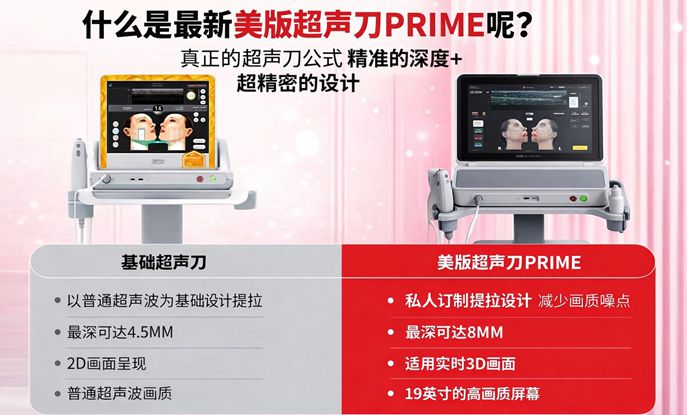
- Imaging System: The fully upgraded DeepSEE® real-time imaging technology features a 19-inch screen (35% larger than the first generation), a 2-fold increased image display area (reaching 10 inches), and clearer visualization of subcutaneous tissues.
- Processor: Dual-core processor, offering 10 times faster processing speed, smoother operation, and significantly reduced image lag.
- Treatment speed: The treatment duration is 20% shorter than that of the first generation.
- Comfort: Thanks to the increased treatment speed, patients are exposed to energy for less time, resulting in reduced discomfort.
- Personalized treatment: Higher-quality images enable doctors to more accurately assess the thickness of subcutaneous fat and the depth of fascia, allowing for more tailored treatment plans.
- Effect durability: Data from the second generation shows that the effects last for 24–30 months, which is approximately 6–12 months longer than the first generation.
Comparative analysis of six key aspects: First generation vs. second generation.
① Treatment effectiveness
This is the most concerning question for many people. Based on current clinical data, the energy delivery methods and the number of pulses per probe are identical in both generations. Therefore, under the same treatment protocol, there is no significant difference in the actual lifting effect.
However, the second generation offers greater precision—higher-quality images allow doctors to target the exact fascial layer, reducing errors due to blurred images. From this perspective, the second generation boasts higher stability and reproducibility of results, especially for patients with atypical facial contours (such as thinner or thicker fat layers).
Additionally, there is empirical evidence supporting the longer-lasting effects of the second generation: Ultherapy Prime® provides results that last for 24–30 months, while the first generation typically yields results lasting 12–18 months—a difference of up to half a year to one year.
| Efficacy Dimensions | First Generation Ultherapy® | Second Generation Ultherapy Prime® |
|---|---|---|
| Immediate Lifting Effect | ✅ Yes (mild post-treatment effects) | ✅ Yes (at the same level) |
| 3-Month Results | ✅ Significant Improvement | ✅ Significant Improvement (more precise results) |
| Peak Efficacy at 6 Months | ✅ Pull-up tightening | ✅ Pull-up tightening (more personalized) |
| Duration of effect | 12–18 months | 24–30 months |
| Customer satisfaction | 95% (after one year) | Expected to be even higher (data is still being collected) |
② Imaging system and accuracy
This is the most significant hardware difference between the two generations of devices.
- First generation: 14–15 inch screen, standard DeepSEE® imaging; image display range of approximately 5 inches, allowing visualization of subcutaneous structures but with limited clarity.
- Second generation: 19-inch larger screen (35% increase), image display range expanded to 10 inches (100% increase); dual-core processor ensures seamless image updates, enabling doctors to see precise subcutaneous images in real time during procedures.
The improved accuracy of the images directly affects the medical decisions made by doctors. Just as being able to “see” during a surgical operation is much safer than operating blindly, the enhanced imaging capabilities of the second generation significantly increase the “confidence” throughout the treatment process, especially in areas with complex anatomical structures such as the zygomatic arch, forehead, and neck, thereby also enhancing safety.
③ Treatment speed
The treatment time for the second generation is approximately 20% shorter than that of the first generation. Taking a full-face treatment as an example:
- Full-face treatment with the first generation: usually around 60–90 minutes
- Full-face treatment with the second generation: usually around 48–72 minutes (about 15–20 minutes shorter)
For busy professionals or travelers seeking cosmetic treatments, saving 15–20 minutes in treatment time, along with reduced exposure to pain, certainly results in a more comfortable experience.
④ Pain experience
The level of pain experienced with the American version of this ultrasound device varies from person to person and mainly results from the thermal effects generated by the ultrasonic waves on deeper tissues. The energy intensity of both generations of devices is the same; however, because the second generation processes treatments more quickly, patients feel more frequent and shorter intervals between each stimulation, resulting in a shorter overall treatment time. Many patients have reported that the pain associated with the second generation is more tolerable than with the first generation.
It is worth noting that the level of discomfort is primarily influenced by the doctor’s technique, the energy settings used, and whether an anesthetic cream is applied, rather than simply by the generation of the device. Choosing a qualified Korean dermatologist with extensive experience is often more important than selecting a particular device generation.
⑤ Price Differences
The purchase cost and maintenance fees for second-generation devices are higher, which naturally reflects in the prices charged by clinics. Taking Seoul, South Korea, as an example:
- First-generation full-face treatment: Approximately 500,000–1,500,000 Korean won (HK$3,000–9,000)
- Second-generation full-face treatment: Approximately 800,000–2,000,000 Korean won (HK$4,800–12,000)
- Price difference: The same clinic typically charges about 20%–40% more for the second-generation device.
In Hong Kong, the difference is even more pronounced—clinics using second-generation devices usually charge between HK$18,000–27,000 for a full-face treatment, while those using first-generation devices may charge as little as HK$12,000–16,000.
⑥ Suitable Candidates
- Situations where the first generation is mo
- re suitable:
– Limited budget but wanting to experience FDA-approved ultrasonic lifting at a
- controlled cost
– Higher tolerance for discomfort - and willing to accept longer treatment times
– First-time user - of ultrasonic devices, focusing on value for money
– Normal skin condition (moderate fat layer thickness), making treatment less challenging for the doctor
- re suitable:
- Situations where the second generation
- is more suitable:
– Adequate budget to pursue a more comprehensive
- treatment experience and longer-lasting resul
- ts
– High sensitivity to discomfort and seeking shorter treatment times
– Sp - ecial facial structure (e.g., very thin or thick fat
- layer) requiring precise imaging guidance
– Having previously used the first generation and wishing to upgrade to the more advanced second generation
- is more suitable:
First-generation vs. second-generation: A comprehensive comparison
| Comparison items | First-generation Ultherapy® | Second-generation Ultherapy Prime® |
|---|---|---|
| FDA approval | ✅ Yes | ✅ Yes |
| Treatment depth | 1.5 / 3.0 / 4.5 mm | 1.5 / 3.0 / 4.5 mm (the same) |
| Image screen | 14–15 inches | 19 inches (+35%) |
| Image display range | Approximately 5 inches | 10 inches (+100%) |
| Processor | Single-core | Dual-core (speed × 10) |
| Treatment Duration | 60–90 minutes | 48–72 minutes (20% faster) |
| Pain Level | Moderate | Slightly lower (due to shorter duration) |
| Accuracy of Results | Good | Higher accuracy (improved imaging) |
| Duration of Effect | 12–18 months | 24–30 months |
| Level of personalization | Standard package | Higher level of personalization |
| Price (Korean won) | 500,000–1,500,000 Korean won | 800,000–2,000,000 Korean won |
| Target audience | Those with limited budgets or experiencing it for the first time | Pursuing precision, long-lasting results, and comfort |
Key point: Which is more important – device generation or the technician’s skills?
Many cosmetic experts and dermatologists emphasize that the effectiveness of the American-made HIFU device depends 50% on the equipment itself and even more on the technician’s expertise and experience.
Even the most advanced second-generation devices may produce inferior results when used by a technician without extensive experience, compared to a seasoned practitioner who has used first-generation devices for thousands of procedures. The reasons are as follows:
- Technicians need to adjust the energy settings and probe selection based on the patient’s skin thickness and elasticity.
- Different areas of the body (such as the jawline, temples, neck) require different techniques and probe angles.
- Preoperative skin assessment and follow-up care also significantly affect the final outcome.
Therefore, before deciding between first- or second-generation devices, it’s more important to ask: “How many HIFU procedures has the technician at this clinic performed? Does they hold any relevant certifications?”
How to find a reputable clinic offering HIFU treatments in Korea?
districts of Gangnam-gu and Cheongdam-dong in Seoul, South Korea, have many clinics offering HIFU treatments, but the quality varies greatly. Here are some practical tips for selecting a reliable clinic:
- Verify genuine equipment authorization: Make sure the clinic provides an official Ultherapy® or Ultherapy Prime® certification issued by Merz Aesthetics to avoid using counterfeit devices.
- Ensure it is performed by a licensed physician: The ultrasonic device must be operated by a dermatologist licensed by the Korean Ministry of Health and Welfare, not by a nurse or technician.
- Check the device model in advance: Ask during the appointment whether the first or second generation device is being used, and request the doctor to explain the reasons for their recommendation to assess their expertise.
- Review real customer reviews: Check online platforms like BeautsGO and Naver for feedback from other patients, especially regarding post-treatment side effects and follow-up visits.
- Beware of excessively low prices: The market price for the full-face version of the first-generation ultrasonic device in Korea is between 500,000 and 1,500,000 Korean won. If the price is much lower, carefully verify the authenticity of the device.
FAQs on common issues
Q1: If I’ve already had the first generation, is it necessary to switch to the second generation?
If you are satisfied with the results of the first generation and the certificate is still valid, there is no rush to upgrade. If you are considering your next treatment and your budget allows it, the longer duration of effect with the second generation (24–30 months vs. 12–18 months) means you can wait longer between treatments, so the cost difference may not be as significant in the long run.
Q2: Is the energy level of the second generation the same as that of the first generation? Will it be more powerful and dangerous due to the upgrade?
The energy delivery method and single-probe settings of both generations are identical; the second generation does not have a “more powerful” design. The improvements lie in the imaging system and operational efficiency, not in the energy intensity. Therefore, there is no difference in safety; both versions are FDA-approved and safe to use.
Q3: If the same clinic offers both the first-generation and second-generation treatments, how should one choose?
It is recommended to first consult a doctor about their assessment of your skin condition and listen to their professional advice. If the doctor believes that your skin structure is particularly complex (such as having intricate facial contours or uneven fat layers), the more precise imaging capabilities of the second-generation treatment are likely to be more worthwhile. For those with more standard skin conditions, the first-generation treatment can still achieve the desired results.
Q4: How soon after the second-generation treatment can one see the results? Are they the same as those of the first generation?
The timing of results for both generations of devices is similar: initial effects begin to appear 1–3 months after the procedure, and peak results are achieved 3–6 months later. The advantage of the second generation lies in the longer-lasting effects, which last 24–30 months, rather than the faster onset of results.
Q5: Is the second-generation Ulthera device cheaper in South Korea than in Hong Kong?
Overall, yes. The full-face treatment costs in South Korea (ranging from 800,000 to 2 million Korean won, approximately HK$4,800 to HK$12,000) are usually 30%–50% cheaper than the corresponding treatments in Hong Kong (HK$18,000–HK$27,000). However, when including the costs of airfare and accommodation, the actual savings may vary depending on individual circumstances.
In summary, which generation offers better results: the first or the second?
To put it simply, the second generation (Ultherapy Prime®) is technically superior to the first generation, but the difference in results is not as significant as one might imagine.
The true advantages of the second generation lie in three key areas:
- 🎯 Greater precision: The upgraded imaging system ensures that each dose of energy is precisely delivered to the target area.
- ⏱ Faster: Treatment duration is reduced by 20%, and comfort is improved.
- 📅 Longer-lasting: The effect lasts for 24–30 months, compared to 12–18 months for the first generation.
For consumers with sufficient budgets who seek the best experience, the second generation is undoubtedly the better choice. For those trying it out for the first time and looking for an FDA-approved treatment at a reasonable cost, the first generation is also a reliable option.
Ultimately, regardless of which generation you choose, it is essential to find a qualified doctor with extensive experience and receive treatment at a officially authorized Merz Aesthetics clinic to ensure safe and effective results. For more information on clinic recommendations and booking tips for the Korean version of this ultrasound device, please continue reading our other articles!